
By Joan Zombek
Early bone-china tea cups had narrow, delicate handles requiring the pinky finger to remain on the outside to balance the cup. Today’s mugs have handles big enough to accommodate four fingers so that the thumb creates the necessary stability. Some Asian restaurant tea cups have no handles to be grasped. To raise, or not to raise the pinky finger, what is the correct etiquette? That question will be answered later.
Geographically, no matter where you make your home, tea is the most widely-consumed beverage after water. Over land and sea, tea travelled throughout history, and according to Greg Beyer, contributing author to The Collector, tea was “the drink that conquered the world.”. Thought to have its origins in northeastern India, tea evolved over tens of thousands of years as it made its way over mountains, through valleys, and across oceans to Great Britain and the American colonies. Early medicinal uses gave way to its inclusion in ceremonial events, rituals, and traditions. The Japanese Tea Ceremony offers an opportunity for guests to enjoy the hospitality of the host in a calm atmosphere “distinct from the pace of everyday life.” (japan-guide.com). British afternoon tea was introduced by Anna, the seventh Duchess of Bedford, in 1840 to assuage her late-afternoon hunger, and so this daily custom was adopted and transported to the colonies. (www.rmg.co.uk).
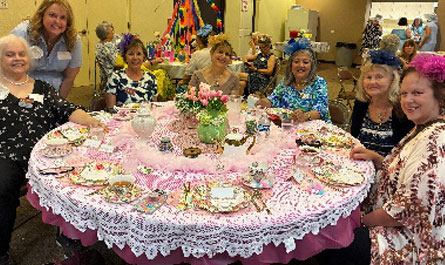
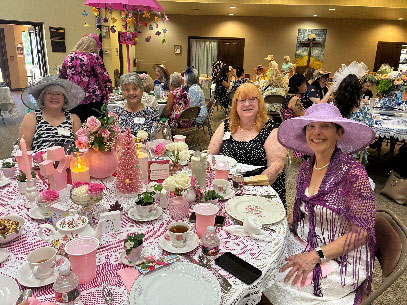
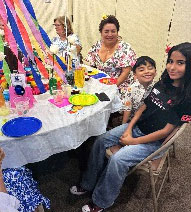
Every year the Seton Women’s Society combines aspects of these traditions into their own unique Spring Tea event. On April 11th, parish ladies of many generations gathered together to celebrate tea’s significance in their lives. Clearly evident were their own special styles and traditions of presenting and enjoying tea. The atmosphere was cheerful and convivial, and the tables were stylishly and thematically decorated by dedicated hostesses who brought out family heirloom tea sets and dishes and skillfully arranged their tables with colorful linens and accessories. The ladies were impeccably dressed in a variety of colors and styles, showing off color-coordinated hats and “fascinators.”
Elegant refreshments included traditional freshly-baked scones topped with lemon curd and clotted cream, and continued with light sandwiches and salads. Chocolate mousse and other delectable baked items completed the meal. Tea pots were full at all times, with different teas available for tasting.
Vocalist/pianist Mary Hollan provided the afternoon’s “exceptional entertainment.” A South Dakota native, Mary now makes her home in Phoenix. Her shows are based on her “background in gospel music and her love of American standards.” (www.maryhollan.org). A variety of the Seton Society’s signature handmade crafts were available for purchase, as were raffle tickets for several prizes.
The festivities seemed to conclude before most of the ladies and their guests were ready to depart from the “oasis-like” atmosphere of that afternoon’s escape from the reality of an ordinary Saturday.
As for the “Pinky Myth,” according to etiquette blogger Katarina, it most likely started with the aristocracy and those delicately-made difficult-to-balance tea cups. Today’s availability of endless varieties and styles of cups and mugs make this practice unnecessary. In fact, she cautions, to raise one’s pinky could be viewed as “snobbish, elitist and rude.”
Ladies, if you enjoyed this Seton Society event, we cordially invite you to join us as a member. Our summer activities committee has already coordinated several lunch outings at popular local restaurants, and we will be working on hand-made craft projects for the holiday bazaar at our weekly meetings.
Sources
Beyer, Greg. 2024. “History of Tea: The Drink that Conquered the World.” The Collector, February.
www.thecollector.com/history-of-tea/.
Hollan, Mary. n.d. www.maryhollan.org. Accessed April 26, 2026. www.maryhollan.org.
“Interesting Facts about Tea.” n.d. Accessed April 26, 2026. www.rmg.co.uk/maritime-history/
interesting-facts-about-tea?
Katarina. 2024. “The Pinky Myth.” The Pinky Myth (blog). February 22, 2024.
www.katarinaetiquette.com.
“Tea Ceremony.” 2020. Japan-Guide.com 2020. https://japan-guide.com.