
by Steve Raml, Director of Liturgy & Music
Our Days Are Numbered
As we move into the summer months, we find ourselves worshipping in an unusual place, a space normally used for parties and meetings; a place we commonly refer to as “the hall.” You might say this is “extraordinary” – because it is certainly “out of the ordinary.”
What an irony then, that we celebrate the weeks of the church calendar called “Ordinary Time,” which will continue into November. I’ve always been quick to point out that there is nothing ordinary about Ordinary Time! Even though we have moved out of the Easter Season, we continue to celebrate the Paschal Mystery that highlights the mysteries of Christ’s life, death, and resurrection. As our old Memorial Acclamation used to proclaim: Christ has died. Christ is risen. Christ will come again!
The liturgical year of the Catholic Church is a sacred rhythm through which believers participate in this Paschal Mystery. You know the major seasons of the Church Year —Advent, Christmas, Lent, the Easter Triduum, and Easter. These culminate in what the Church calls Ordinary Time.
Although it makes up a substantial portion of our liturgical year, we may have some misunderstandings of Ordinary Time. I think this is mainly because of our many definitions of the English word “ordinary.” We tend to think of it as “mundane,” “everyday,” “just the usual” or “humdrum.” However, the Latin for Ordinary Time, tempus ordinarriis more precisely translated as “Ordinal Time” — time that is counted; in other words: “numbered days.” Some of you may have learned your “Ordinal Numbers” in grade school math class, numbers that followed one after another in sequence, as in “first” “second” “third” etc.
There’s really nothing unusual about this counting. There’s no great spiritual benefit to knowing that a particular day is the 16th Sunday in Ordinary Time. It’s simply a way of marking our time, a way of keeping in order the Scriptures in the lectionary, the psalms in the psalter, and the prayers in the Sacramentary.
Ordinary Time occupies the largest portion of the liturgical year and carries deep theological and spiritual meaning. It is a time when Catholics are invited to grow in faith, deepen their discipleship, and live out the mysteries of Christ in the ordinary circumstances of life.
Ordinary Time is not really a season. But it might be easier to look at three sections of Ordinary Time that occur each year as seasons: Winter Ordinary Time (after Christmastime until Ash Wednesday), Summer Ordinary Time (after Eastertime until around Labor Day) and Fall Ordinary Time (early September until Advent).
Deep In Theological Meaning
Each section ties together the whole liturgical year with readings and prayers that highlight different scriptural themes. Winter Ordinary Time continues the images light that Christmas introduced with Gospels that focus on the call of the disciples and Jesus’ early ministry. During Summer Ordinary Time, we’ll often hear Gospel parables of farming and harvesting and other readings that form us in faith. Fall Ordinary Time brings us a set of readings that focus on Christ’s coming again in glory, which leads us into Advent’s time of waiting.
From a theological perspective, the Church teaches that Ordinary Time is a season of spiritual maturation. The General Norms for the Liturgical Year tell us that during Ordinary Time, believers come to know Christ the teacher and healer, the one who reveals God’s kingdom in word and deed. The theological purpose of Ordinary Time is therefore catechetical: to help Christians internalize the values of the Kingdom of God and translate them into ordinary living.
Living the Mystery in Everyday Life
The Church’s teaching stresses that holiness is not confined to extraordinary moments but can be found in the faithfulness of daily living. Thus, Ordinary Time reminds us that the Christian vocation is lived primarily in the ordinary, day to day realities of work, family, friendship, and service. In this sense, the season is deeply incarnational—it affirms that God is present in the ordinary flow of human history and that grace permeates even the most routine moments of life.
Pope Francis often emphasized this theme in his teaching, encouraging Christians to find “the holiness of the next door neighbor,” those who live virtue quietly and faithfully without any public recognition. Ordinary Time forms the context for this kind of holiness, as believers cultivate virtues such as patience, humility, compassion, and hope. The routine of the liturgical year mirrors the rhythm of the spiritual life: there are moments of intensity and celebration (like Christmas and Easter), but also long stretches of steady growth and perseverance.
The Role of the Liturgy in Ordinary Time
In liturgical practice, Ordinary Time emphasizes the proclamation of the Word of God and the Eucharistic celebration as nourishment for ongoing discipleship. The Sunday readings during this time focus on the life and teachings of Christ and the moral and spiritual implications for the Church. Through the readings and homilies, we will be reminded that discipleship requires continual conversion and attentiveness to Christ’s example.
During Ordinary Time, the lectionary covers large portions of the synoptic Gospels (Matthew, Mark, and Luke) over a three year period, ensuring that we are exposed to a comprehensive view of Christ’s earthly ministry. This systematic presentation helps believers integrate the message of the Gospel more fully into their personal lives. The steady pace of Ordinary Time invites reflection and assimilation rather than emotional intensity, giving space for a deeper and more sustained transformation of heart.
Feasts and Solemnities in Ordinary Time
Though Ordinary Time lacks a major overarching theme like Advent’s expectation or Lent’s repentance, it is enriched by numerous feast days that highlight key aspects of the faith.
Among them are the feasts of saints—men and women whose lives exemplify fidelity to Christ in diverse circumstances. The celebration of saints on the weekdays of Ordinary Time reminds us that holiness takes many forms and that sainthood is attainable in every vocation, including the most ordinary. In addition, we pause in mid-August to honor the Virgin Mary for her Assumption in Heaven.
Major solemnities like the Most Holy Trinity, Corpus Christi, begin our summer Ordinary Time and Christ the King in November brings the long summer-fall Ordinary Time to end. These feasts frame Ordinary Time with profound theological significance.
The Solemnity of the Most Holy Trinity focuses on the mystery of God’s inner life—Father, Son, and Holy Spirit—revealed through Christ. Corpus Christi emphasizes the ongoing presence of Christ in the Eucharist, the sustenance that carries believers through ordinary life. The Solemnity of Christ the King, which concludes the liturgical year, points toward the ultimate fulfillment of time in Christ’s eternal reign, linking everyday faithfulness with the eschatological hope of salvation.
Spiritual Growth and Mission
Spiritually, Ordinary Time calls us to integrate our worship with mission. The celebration of the Mass each week becomes the source and summit of our Christian living, sending us forth to transform the world in small yet meaningful ways. The Church’s mission—proclaiming the Gospel and witnessing to Christ in word and deed—unfolds primarily during this long, “ordinary” season. It reminds us that evangelization is not confined to special undertakings but is lived continually in acts of love, justice, and mercy.
This call to mission underscores that Ordinary Time is anything but spiritually ordinary. It is the heartbeat of the Church’s year, a sustained invitation to live the Gospel in practical, transformative ways. The repetition of weekly worship, Scripture reading, and prayer becomes the training ground for perseverance and maturity in faith.
Colorful Symbolism
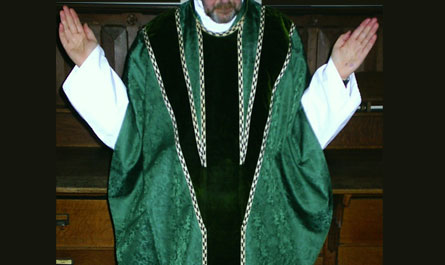
The liturgical color for all of Ordinary Time is green, which we see mostly in the vestments the priest wears as he presides at Mass. Green is a color that evokes the growth of grass and leaves on a tree. That is an effective way to look at the purpose of Ordinary Time: growth. Just as green plants flourish in the natural world, the color green signifies that we grow in our faith, formed by the prayers, readings, and music of this time.
Ordinary Time in the Church, far from being a mere filler between more “important” seasons, is a profound period of grace and growth. Rooted in the ordered unfolding of God’s time, it invites us to encounter Christ in the everyday—through Scripture, the sacraments, and the ordinary duties of life. Holiness arises through consistency in prayer, charity, and faithfulness. Ultimately, Ordinary Time reminds us that every day belongs to God and that through Christ, even the ordinary becomes extraordinary.
As Christians, we number the days until Christ returns in glory; a point at which time as we know it will cease, the dawn of a new day, a new time — a time when the darkness of night will never fall, and the light of day will be eternal — the eighth day of the week that is forever.





Excellent article. Even with Catholic grammar school and many years of (79) going to church and involvement in activities, this explains in detail what Ordinary actually is. Thank you very much for this comprehensive article that most Catholics don’t know.