
By Becky Schlofner
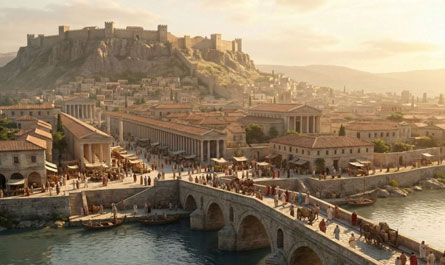
Antioch was a powerhouse long before it became a pivot point for religious history. Founded around 300 BC by Seleucus I Nicator, one of Alexander the Great’s generals, the city was designed from the start to be a massive capital for the Seleucid Empire. It was named after his father, Antiochus, and built with a sophisticated grid system that was way ahead of its time. For centuries, it served as a major center of Hellenistic culture, where Greek philosophy, art, and language flourished, acting as a bridge between the Mediterranean world and the deep interior of Asia. When the Romans eventually showed up and took over in 64 BC, they didn’t tear it down; they leveled it up. They turned it into a regional capital with grand colonnaded streets, massive public baths, and a famous circus for chariot racing that could hold tens of thousands of screaming fans.
The existing atmosphere of intellectual curiosity and cultural mix is exactly what made it such a fertile ground for innovative ideas. So, when the travelers that were following Christ came to the town of Antioch, the literal crossroads of the world, they found many interested. Instead of a small, isolated group, the early believers in Antioch were operating in a city that was a literal crossroads of the world.
The shift from a Hellenistic stronghold to the “cradle of Christianity” happened remarkably fast. While the city continued to enjoy its status as a Roman jewel, the underground energy of the new followers of Christ began to redefine its legacy. The same streets that saw Roman generals parading in triumph were the same ones where Paul and Barnabas argued about theology and organized the very first international missions.
Antioch’s role in Christian history goes even deeper than its name or its famous missionaries; it eventually became one of the “Pentarchy,” the five major centers of the early Christian world alongside Rome, Constantinople, Alexandria, and Jerusalem. This city was the intellectual powerhouse of the early Church, specifically known for the “School of Antioch.” Unlike the thinkers in Alexandria who loved to interpret the Bible through symbols and allegories, the scholars in Antioch were all about a literal and historical approach to the scriptures. This sparked massive theological debates that shaped the very creeds many people recite today.
One of the city’s most legendary figures was John Chrysostom, whose nickname means “Golden-Mouthed” because he was such a killer public speaker. In the late 4th century, his fiery sermons in Antioch became so famous that he was eventually dragged off to become the Archbishop of Constantinople. During this era, Antioch was a city of contrasts, where the massive, octagonal “Great Church” commissioned by Emperor Constantine stood as a symbol of the new state religion, even as older pagan traditions lingered in the nearby sacred groves of Daphne.
The city also became a pioneer in how the Church cared for the poor. The Christian community in Antioch developed one of the first sophisticated systems for social welfare, feeding thousands of people and providing medical care, which was a revolutionary concept in the ancient urban world. This wasn’t just a religious hub; it was a laboratory for how a faith-based community could function on a massive scale. Even after the city was devastated by a catastrophic earthquake in 526 AD and later Persian raids, the “Patriarch of Antioch” remained one of the most senior titles in Christendom, a legacy that continues today in several different church traditions that still trace their spiritual lineage back to those same bustling, ancient streets.
Even as the city eventually faced its decline through natural disasters and warfare, its dual identity as both a pinnacle of ancient urban planning and the birthplace of a global religious identity remained etched in history. Today, the modern landscape might look different, but the legacy of that bustling, diverse ancient metropolis still echoes through the name of the movement that first found its footing there.