
By Luciana Ballesteros-Heras
Is faith inherited? Is faith taught? Is it learned? Or is faith just instilled, planted in someone’s heart like a little seedling prepared to flourish and prosper into a magnificent blossom? Perhaps those who acquire faith later in life can remember its conception more clearly than those who obtained it as mere infants, or perhaps the reality is that the matter does not concern faith’s origination but its development. What good is knowing how a seed wound up in the soil if no one cares enough to water it? This is the spiritual nourishment that St. Elizabeth Seton’s Religious Education program (abbreviated RE) has provided children with for years. Although children are presumed to know the least, they have the will to learn. All they need is somebody willing to teach them.
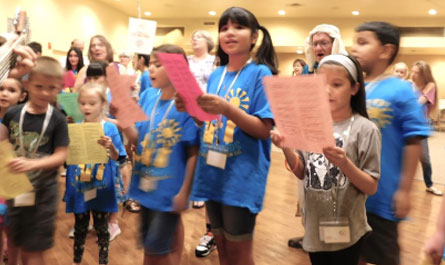
Each Wednesday evening children aged six through eighteen (grades 1-12) gather in Parish Hall to attend their classes, which last from 6:00 to 7:30 PM. Each session begins in the same manner, with the participants seated on the floor gathered around Dcn. Jeff Arner, as the students listen intently to the Gospel of the following Sunday read aloud from a children’s Bible. Following the reading, they discuss (quite insightfully) the Gospel’s content. With Dcn. Jeff providing guidance, their minds promptly go to work trying to decode the message that the voice of God was sending them.
Following this “homily”, one of the children is selected to lead the rest in praying a decade of the rosary, reflecting on the corresponding mystery. They then branch off into their respective classes divided by grade, with the youngest students comprising the primary class. Following their graduation from this primary level, students launch into their sacramental classes. Those in second and third grade are typically in intense preparation for their first Sacrament of Reconciliation, with concepts such as cleansing, forgiveness, and remission being stressed throughout their lessons. With clean hearts and uplifted souls, they complete their first Confession towards the end of the school year and raise their eyes to their Confirmation and first Communion, both combined into one class.
As the year elapses, with the joyful prospect of summer liberty, the brisk gratifying autumn breeze, the ebullience of the Holiday season, and the delirium of recommencing their schooling after a lengthy winter repose has faded into the past, now in the presence of springtime a row of merry children clad in white stands at the threshold of the church, hearts pounding and minds racing, ready to receive the gifts of the spirit and body of Christ after ample preparation. But their journey in faith is far from complete; on the contrary, it has scarcely begun.
While the classes that were comprised of 4th-5th, 6th-8th, and 9th-12th graders did not specialize in a specific sacrament, this “Bible study” format of religious education is equally as crucial. Each night, as students depart under a canopy of glistening stars, they realize that they had left their class with a broadened apprehension, a deepened understanding of their beliefs, and unequivocally more knowledge of their faith than they came in with.
Perhaps there is no greater joy in a child’s life than jubilant celebrations. Throughout the school year jovial parties and exuberant festivals stress the significance of liturgical events such as Holy Week, Pentecost, All Soul’s Day, All Saints’ Day, and Christmas. Liturgical seasons were also acknowledged. During the forty days preceding Easter, light was shed upon the three pillars of Lent: prayer, fasting, and almsgiving. Similarly, Advent contained an abundance of lessons on hope, peace, love and joy. That delightful Christmas story was indelibly ingrained in the children’s memories after those four weeks that were filled with quiet preparation. Plainly, these events were more than simply mirthful celebrations. In a world enveloped by consumerism and superficiality, they were windows into the profundity and authenticity of their religion.
A body is the sum of its parts, and nothing could be more elucidative of this than St. Elizabeth Seton’s RE community. Each dedicated volunteer is a vital piece of a daedal puzzle, a working cog of a moving machine. Under Linda Watkins’s direction, catechists meticulously construct lesson plans and enlighteningly educate their pupils week after week, inculcating in them an even more fervid fascination of their faith. These are the instruments of the Lord, the echoes of His voice, and reflections of His love.
Matthew 19:13-14 states: “Then the children were brought to Him that He might lay His hands on them and pray. The disciples rebuked them, but Jesus said, ‘Let the children come to Me, and do not prevent them, for the kingdom of Heaven belongs to such as these,’” and there are no better words than those of Christ to describe the aim of St. Elizabeth Seton’s Religious Education program.