
By Joan Zombek
Tenebrae is one of many solemn, sacred rituals Christians observe during Holy Week, when we reflect on the final days of Jesus’ earthly life. The Sisters of Carmel, a cloistered contemplative religious order, highlight the somber atmosphere of this “service of Matins and Lauds” by its funeral-like atmosphere and manifestation of Holy Mother Church’s grief. Each day of the Sacred Triduum is guided by a basic form of the Divine Office, also known as the Liturgy of the Hours, and limited to “psalms, lessons and chants expressive of grief.” These include the lamentations of Jeremiah and notably mournful hymns and psalms (www.sistersofcarmel.com).
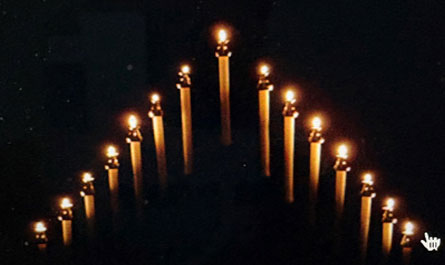
Meaning “darkness” or “shadows” and originating during medieval times, “the Office didn’t begin until about 9 or 10 in the evening.” The only visible light in the church was provided by fifteen candles displayed in a holder known as a “hearse,” with the center candle symbolizing “Our Lord Jesus Christ” at the highest point. At the conclusion of each recitation of the “nine Matins and five Lauds,” a candle was snuffed out in an alternating pattern starting from the bottom until only the center candle remained lit, which symbolized Jesus Who was “left alone in the darkness of the world, fraught with sin.” After reciting the final prayer, this lone remaining candle was then extinguished plunging the church into complete darkness, and a loud noise was heard “symbolizing the earthquake at the Crucifixion.” At this, the Office ended abruptly, and the faithful vacated the church in silence (www.angeluspress.com).
Our parish observance of Tenebrae is always inspirational and well attended, and it differs in several ways from the original medieval practice. The Magisterium permits parishes to choose hymns, psalms, and readings that are appropriately meaningful to each congregation and to tailor the event to the needs of the parish. On the evening of Wednesday, April 1 six candles on each of the two altars provided light in the dimly lit sanctuary, with last year’s Pascal candle symbolizing Jesus. Deacon Jeff officiated, and the choir led parishioners in commencing this annual observance with the haunting words and melody of Wondrous Love. Following the opening prayer, the mournful stanzas of Psalm 54 sought God’s assistance, but concluded with the realization that “the arrogant have risen against me; the ruthless seek my life.” After this and each successive element of the service, two candles were extinguished.
The Lamentations of Jeremiah called us to “return to the Lord, your God.” Then we heard some of Jesus’ final words from Psalm 22: “My God my God, why have you abandoned me?” The Scripture reading from 1 Peter 2:21-24 served to remind us of that Jesus, the innocent Lamb of God, willingly suffered physical, mental, emotional, and psychological anguish to restore us to God’s favor. As the church lighting continued to dim, the congregation sang, “O Sacred Head Surrounded.” The Gospel Canticle implored the Lord to save us during our waking hours and “guard us in our sleep, that we may keep watch with Christ, and rest in his peace.”
Upon extinguishing the last two candles, parishioners recited the Lord’s Prayer, followed by a final prayer and the blessing. In silence, the Pascal candle was extinguished, followed by a simulated rumble of thunder, representing the moment at which Jesus gave up His life. All exited the church in the silent darkness, pondering the events to unfold in the coming days. Tenebrae served once again as a reminder of the magnitude of God’s eternal love for his adopted children.
Sources
“Doctrines & Dévotions – Tenebrae.” 2026. Sistersofcarmel.com. April 22, 2026. https://
Press, Angelus. 2024. “The History and Symbolism of Tenebrae.” Angelus Press. 2024. https://
Raml, Steve. 2026. “Tenebrae.” in St. Elizabeth Seton Worship Aids, 1-4. Sun City, AZ. St.
Elizabeth Seton Catholic Church.